


sapper756
-
Posts
36,138 -
Joined
-
Last visited
Content Type
Profiles
Forums
Events
Everything posted by sapper756
-
Bump
-
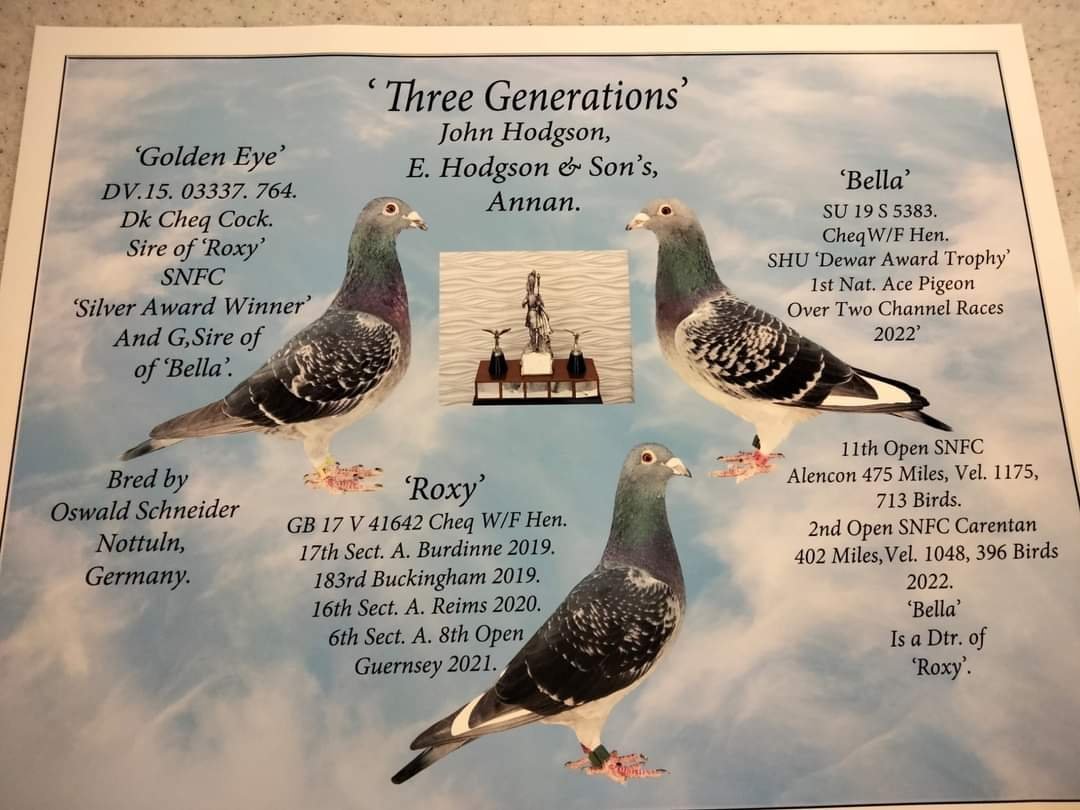
The Joe Murphy Column I have had a few nice phone calls regarding last week’s article which highlighted my visit to Jim Biss; I found another folder with some extra photos in it, this contained the very good pigeon called ‘Basher’ see photo; who was a decedent of the ‘Vale Cesar’. ‘Basher’ was bred in 1995 and won the following positions for Jim Biss; 1 st section 22 nd Grand National Pau 645 miles in 1998; 8 th National Marseilles 668 miles in 2000; 10 th section 261 st open Grand National San Sebastian 2001 flying 662 miles; 10 th Gellenville 2001; 16 th section Nantes National 2002 from an entry of 10,150 birds; 1 st National Marseilles 2002 beating 15,022 birds from this International race. Sire was Nomad; bred from Bear x Vale Cesar; Dam of ‘Basher’ was a daughter Dali from Silvere Toye. Another Memory While going on about my reminiscing above; I remember Cameron Stansfield who was the editor of the BHW at that time, wrote article; ‘Five out of 6 Ain’t Bad’; this was about John & Julia (his daughter) Barnett of Telford. Who had prepared just 6 pigeons for 3 open races; entering 2 into the NFC Pau event (they were liberated at Saintes instead), 2 for the Midland NFC Bergerac race and 2 for British Barcelona Club race from Bordeaux. All 6 were cocks - but the thing that impressed me was this was NO Widowhood set up. Each of these cocks was raced natural, and their cycles had not been broken since being paired in March. Two cocks were sent to the NFC race; however, these were brought back to Saintes and were liberated at 17-00 hours; thus, also reducing the 653-mile trip to one of 488 miles. John and Julie didn't know what to expect in terms of an arrival time for their entries; however, they timed a 4-year-old chequer cock seconds before noon and he was to win 1 st section J, 53 rd open, from an entry of 2,770 birds. As a youngster this cock was the only bird on the day into Telford from the young bird national and his breeding could be traced back to 67F1389, who scored from Pau on the day in 1970 for the legendary Cyril Ball & Sons of Telford (who was a household name within our sport). This pigeon had won 2 nd Shropshire 500-mile club; 2 nd Wrekin Federation Championship Angouleme flying a distance of 500 miles. He also won 126 th open NFC Nantes; 18 th open Pau NFC and 31 st open Pau NFC flying 650 miles ON THE DAY. He also won 46 th section Lamballe NFC. So, you can see reading the above he was a quality pigeon indeed. The Barnett’s 2 nd entry was a 2-year- old chequer cock who won 5 th section J & 156 th open flying 559 miles. The BBC let their convoy go at 06-15am and the MNFC Bergerac birds were airborne at 07-00am and John and Julia were looking for pigeons when on 11 hours 17 minutes, their 2-year-old chequer cock swung into view and was promptly clocked. A natural pigeon from an 'old-fashioned' lineage, showed the versatility of the Barnett pigeons. He ended up winning 8 th south-west section, 30 th open from an entry of 2,016 birds. In his previous race he had won 4 th section J, 26 th open NFC from Saintes on the 21 st of June from an entry of 4,526 birds. He is the nestmate of the cock mentioned earlier who won 5 th section Pau/Saintes. The dam of this pair was the only bird on the day in the Telford area from the 2000 young bird national; and their sire is a full brother to the sire of their 1 st section J from the Pau/Saintes race in 2003. Then at 18- 24pm their 2 nd Bergerac entry arrived; he was another 2-year-old chequer white flight cock. He won 10 th south-west section, 35 th open to add to his 51 st section, 435 th open NFC Saintes 5 weeks earlier. He was a full brother to the dam of their 5 th section Saintes/Pau and 30 th open Bergerac 2003 winner, being bred from John's and Julie's No. 1 stock pair, who were a dark chequer cock ‘Peanut’ and a blue white flight stock hen, they were also parents of 27 th & 38 th open NFC Saintes. The BBC Bordeaux race birds were liberated at 06-15am, which was 45 minutes earlier than the Bergerac birds, although racing a The Joe Murphy Column similar distance but on a different line. Also, the structure of the convoy was different with most of the 1,574 birds heading into a wide front along the south coast of England. Although their hopes were high of recording day birds, this was not to be, but they didn't have to wait long the next morning to welcome their 3-year-old chequer cock who won 7 th section E, 356 th open. This cock had taken 15 th section 89 th open NFC Saintes on the 21 st June. He was a grandson of ‘Bella Donna’ a winner of 2 nd section J 6 th open NFC San Sebastian, flying 648 miles on the day in 2001. His sire is the brother to the sire of 1 st section Saintes, 5 th section Saintes, 30 th open Saintes and 30 th open Bergerac, and he is a brother to the dam of ‘Bella Donna’. John and Julie had to wait another 3 days for their 6 th entry to return home, however, he had hit the wires so it was not surprising he was late home. This article had an intense impression on me that I contacted Cameron for the Barnetts phone number and made contact with John. Who invited me down to visit him and see the pigeons which I did. I spent a lovely day seeing their famous ‘Belladonna’ who won a 486 th open Sartilly NFC young bird race from an entry of 8.366 birds. She was also won 10 th open 1.800 birds NFC Bergerac flying 559 miles; she won 2 nd section 6 th open NFC San Sebastian 5.570 birds; flying 648 miles ON THE DAY. Then there was ‘Peanut’ who flew Saintes 489 miles on the day and was then put to stock. The ‘NO RING BLUE COCK’ bred for stock by C Ball & sons of Telford, he was bred from 9 th open Pau x Ref A winner of 18 th & 31 st open Pau flying 650 miles on the day & 7868 winner up to Pau. ‘The Palamos Hen’ winner of 81 st -101 st & 186 th open Palamos flying 791 miles. It was a wonderful experience to meet the Barnett family and see their pigeons, and needless to say I ordered some of their family, in fact we became very good friends; and they had some of my ‘Mystical Rose’ bloodlines sent down to them. I would often meet up with them at Blackpool Show as they had a stand there. Wonderful people and a Great family of Distance pigeons, happy memories indeed. Now for something up to date!!! Scotland’s Bird of the Year 2022 The above winner of this wonderful accolade is a 3-year-old chequer white flight hen bred and raced by that wonderful fancier John Hodgson of Annan, who has won the Scottish National Flying Club 7 TIMES. These wins are as follows; Sartilly (2) in 1986; Sartilly (1) in 1987; Rennes in 1990; Sartilly (2) in 1990; Sartilly (1) in 1991; Falaise in 2008 & Clermont in 2020. So, you will see John is a household name within the annuals of Scottish National Flying Club. John has named his winning Dewar Trophy hen ‘Bella’; as a young bird she scored in the club and flew the SNFC young bird national from Buckingham a distance of 226 miles. Then as a yearling she scored in club and flew from the SNFC Maidstone race (305 miles) and she also flew from this same race point with the SNFC as 2-year-old. In 2022 she flew Guernsey a distance of 382 miles with the NFC prior to going to the SNFC Alencon race where she won 11 th open flying 475 miles recording a velocity of 1175.91 competing against 713 birds. Then from the SNFC Carentan race a distance of 402 miles ‘Bella’ won 2 nd open doing a velocity 1046 competing against 396 birds. The breeding of ‘Bella’ is as follows her dam is ‘Roxy’ a SNFC Silver Award winner; her positions are as follows; In 2019 she won 173 rd open SNFC Buckingham and then won 17 th south section SNFC Burdinne 2019. In 2020 she won 16 th south section Reims and then in 2012 she won 6 th section 8 th open SNFC Guernsey she is 100% Oswald Schneider; Regarding the Oswald Schneider pigeons; John had this family for the last 12 years and these are direct from Oswald who lives in Notulin in Germany. They are an exceptional family of long-distance pigeons and he flies 767 miles from Barcelona and Oswald is one of the The Joe Murphy Column furthest flyers in Zone 3. Her sire is 50% Oswald Schneider and 50% Louella Jan Aarden down through ‘Icarus’ a (Silver Award Winner) ‘Icarus’ positions are as follows; 1 st south section 49 th open SNFC Alencon; 13 th south section 60 th open SNFC Falaise; 7 th south section 9 th open SNFC Newbury; 148 th open SNFC Maidstone; 150 th open SNFC Newbury; 432 nd open SNFC Newbury and 14 th south section 21 st open SNFC Alencon. So, you will see that ‘Icarus’ has scored 7 out times and he missed out on his 8 th SNFC race by one position. His lines are ‘Smaragd’ 1 & 2 plus ‘Invincible Spirit’. So, you will see that he is bred for the job. John has kindly forwarded me a photo of his Dewar Trophy Winner and also a photo of John holding the Dewar Trophy and the J Renwick Trophy. Once again, I send my congratulations to John and thank him for supplying the details of his winning pigeon. Joke Three Irishmen are sitting at the pub window, watching the front door of the brothel across the street. The local Methodist vicar appears and quickly goes inside. ‘Will you look at that’ says the first Irishman ‘Didn’t I say what a bunch of lying hypocrites they are’. No sooner are the words out of his mouth when a Rabbi also goes inside. ‘There’s another bunch who try to fool everyone with their pious preaching and funny little hats’, says the second Irishman. They continue drinking roundly condemning the vicar and the rabbi when they see their Catholic priest sneak inside. ‘Oh how sad says the third, one of the girls must have died’. Please continue to keep the news flowing; to Joe Murphy Mystical Rose Cottage 2 Flutorum Avenue Thornton by Kirkcaldy KY1 4BD or phone 01592 770331 or Email to joejmurphy1@gmail.com REMEMBER THE J IN THE MIDDLE or you can also view online editions on: www.elimarpigeons.com www.fancierchat.co.uk www.pigeon-chat.co.uk - www.Pigeonbasics.com - Pigeon Racing the Basics! - thecanadianpigeoninternational.com www.internationalracingpigeon.com Who wish my weekly contribution portfolio on pigeon topics from Scotland? © COMPILED BY JOE MURPHY
-
-
-
-

-
-
Well here's part 2 of David Reynolds Dandilofts reflections of his tremendous long distance/Marathon racing season from 500 to 800 miles (the photo is just one bird from his high performing team Enjoy! Dandilofts Marathon Pigeons Autumn time to reflect and make the difference for next year Part 2 Breeding: The first step to a successful breeding season is the preparation of the birds and the loft , Both are important as part of the breeding season however the health of your birds is paramount at this time for future generations of racing birds within the loft as this has a direct influence on the race results for years to come. Without solid healthy foundations the breeding programme could and probably would fail or , at worst only produce a generation of mediocre racing birds failing to produce the results that I expect to achieve as well as taking up valuable space within the loft that could have housed a champion . So all the birds have to be tested by a laboratory and subsequently treated for what ever they were diagnosed with ,this is in many cases not possible to do due to having no access to a local laboratory and so many have no alternative as to treat blind in order to achieve a minimal level of health within the loft but the facts remain if you do not or can not test them you can never be 100% satisfied that the pigeons are 100% healthy . The blanket administering of antibiotics is not ideal and in my opinion aiding in the large amount of losses .So at this point now I am sure that the team of birds that I have are healthy ,and the first stage of selection of the pairs can begin . I find that winter is a great time to do this as there is more time to contemplate the many variables that go into the these very important decisions. “The following is a list of what I consider when making the pairing lists for the upcoming breeding season” The parentage ,where in your strain does the bird fit? has it been newly crossed? or is it inbred/outbred maybe a strain founder or fixed point in the strain? also what has this bird produced in previous breeding seasons ,maybe a son or daughter maybe a grandson that in turn has produced a winner or a regularly placing in the top spots. This is when, good record keeping is essential after all we are all getting older and the old gray matter can let you down sometimes but pen and paper (or a computer) tells the story with accuracy. It is a stage for much deliberation and lots of frustration ,I must change the pairing at least 4 times before I am happy with them and go to print. Anatomy , How is the bird in the hand, this will tend to be a personal preference as I think we all have our own ideal build or way the bird should feel when in the hand. I am one that leans toward a small but firm body with a tight vent and a flat breast bone that is obscured by the muscle to give the bird a round feel ,I think it was Hans Eijerkamp that said “ you can feel the harmony of the pigeon and that it vibrates in the hand” (when in form) ,I would prefer to say its the balance of the bird laying well in the hands, it just feels right . The wings ,you could write a book with all the theories there are out the about how a wing should be for long distance or sprint etc etc .The only thing I like to see is that the last 3 flight feathers are well spaced and of the same length, this is not something that is found often but in my experience this wing is a great long distance wing with a of potential to cover the marathon distance up to 1,000 miles ,this is also why it is so rare, In my opinion The Eye I am not going to get into this in any way shape or form , I like a bright clear eye in which you can sees the vitality and character of the pigeon , any other observations are for the theorists to decipher. The feathers these are also important but I have found that the feathers will be good if they get all the vitamins and minerals they require as well as access to regular baths a nice silky feel and full body feathers is the look you should be achieving if not maybe it shouldn't be bred from? Performances Here we go the most important part of the selection process but also the easiest .The best bird gets paired together with the 2nd best bird ,providing that all the above criteria have been satisfied,this part is not rocket science the apple never falls far from the tree, that's why we should always try to stay as close to the tree as possible ,until such time as the tree has produced another tree ,some of the later born offspring will be better than the original which makes full sense as the times and conditions have also changed and developed the new generations are bred to cope with the new situation like 5G or the change in the earths magnetic field's or even YB sickness Age not wishing to be branded an ageist breeder, but the vitality of a 12 year old bird is not the same as a 2 year old, so just looking to ensure you keep the young with the old can produce some great offspring full of vitality and racing spirit, after all a young Hen will tend to keep even the oldest of cocks on his toes and may help him filling his eggs and vice versa. Having now selected the pairing on paper I like to do a test pairing but before I can do this I have to prepare the lofts,this is the not as I have explained in part one with rebuilding and and the such like its the moving of the different birds to there new sections, I have or will have the following sections distance cocks, the sprint cocks new to Dandilofts in 2021 and the yearling cocks. Then the same for hens each adjoining the cocks sections , I like to pair the birds for 3 or 4 days in their new boxes and sections and then train them on the roundabout,some are very stubborn and don't like moving from there old section but I persevere they will get it eventually .Two days training with the cocks and most birds will have settled in so now the cocks have the boxes during the day and the hens during the evening and over night ,just for a couple of weeks ensuring the two don't meet ,then the breeding season can begin . The start of the season is very soon upon me and it starts for the race birds with the pairing up at the end of February, my first race being the first weekend in May .The birds are now not only breeding but also learning what is going to be expected from them for the rest of the season .The best way to get this across is to run through what actually happens. While sitting on the eggs the cocks and hens are let out once a day just to get a bit of exercise and to keep the BOP aware at the forefront of there thinking of course this is a risk but if I was to keep them in the first few times I let them out again the losses would be very a catastrophic as they wouldn't be attuned to the danger so to that my birds are out the whole winter and the complete breeding period. When the young birds are 14 days old the hens are put into their own section during the day let out at about 3:30 pm to fly while the cocks are then driven into the hen section , this is the true start of the roundabout system which you can read about in the article Dandilofts Marathon Pigeons The System Motivation here we have a subject that is open ended with unending variables on the same theme i.e.: the motivation of our feathered friends .What is a safe bet is that as a racing pigeon trainer it is my responsibility to ensure that I get he best out of the birds in any situation and at every distance and in order for me to achieve this I have to be in touch with each and every bird in the my loft they are after all in my opinion all individual and so can be better motivated by treating them on there own merit . I am a pigeon crazy person as many of you reading this will also be.,I spend hours and hours in the lofts not just watching the birds but talking to them and enjoying there company ,now many of you will be laughing but I find that the birds respond well to this interaction and indeed thrive on it. I will discuss the mistakes made on the last race I will praise the team or indeed individuals when they have raced well. Having the birds all on the roundabout the motivation on the distance races is 24 hours with the partner before I basket them for the race but with some little tricks like putting a second hen in the box with a aggressive hen can produce some great results just be careful a hen fight can be more deadly than the cocks,another trick for the cocks is for a white cock to be put in the box before the box owner comes back in ,as this will send the territorial instinct from the cocks into overdrive ,but once again be careful the white cock can not live in the section with them as he will be under constant attack. This is an insight into the way I at Dandilofts prepare and select my birds for breeding as well as the few little things that can be done to motivate the birds to Race up-to 1,000 miles for at the end of the day you have to have the base birds containing the correct genes in order to breed top birds that will race at the distances you want them to . For new starters and those that are struggling to get to where they want to be I would suggest you go to the best loft you can to source the best birds for the distance you want to achieve two top birds to start with is better than 10 mediocre birds that will just hold you back. Many thanks for reading this information and good luck Regards David Reynolds Dandilofts marathon pigeons Relentless in the execution of objectives
-
-
-

-
-
-


-

-
-

-
-
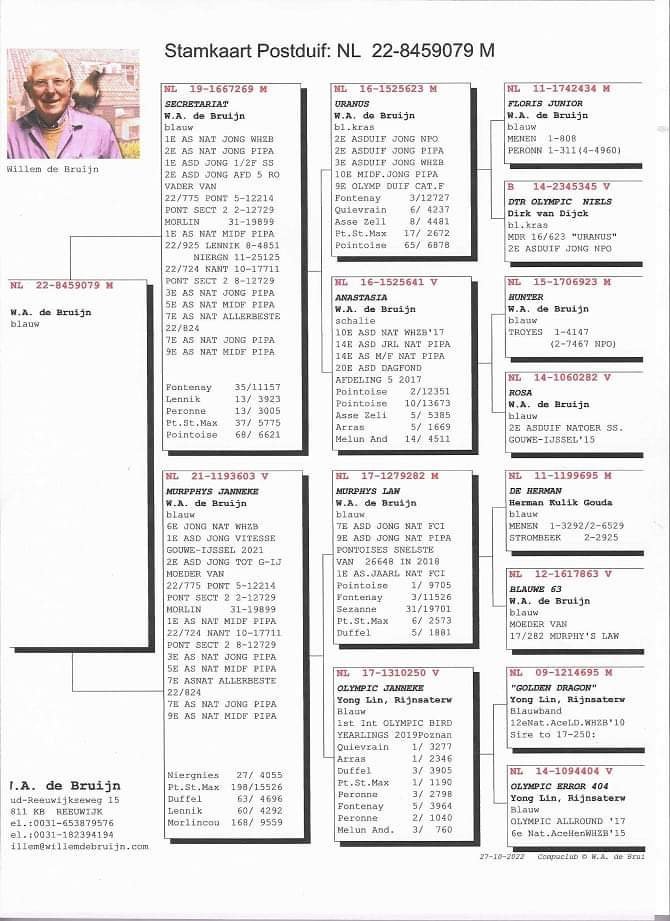
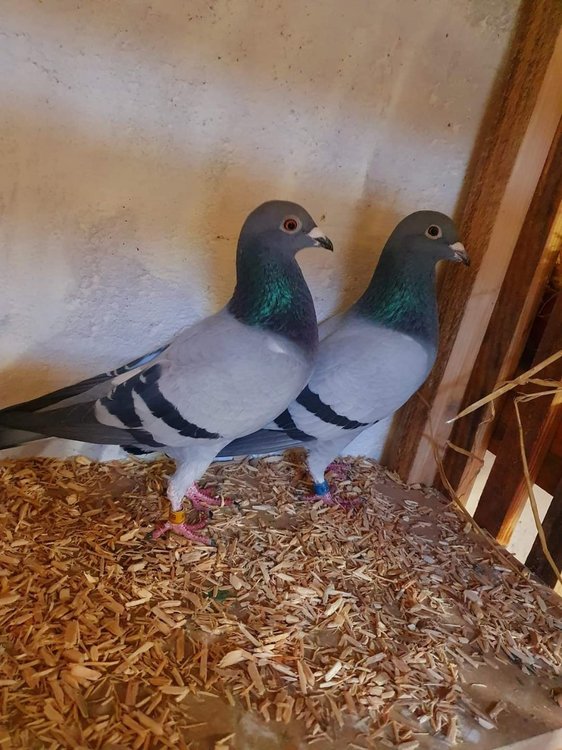
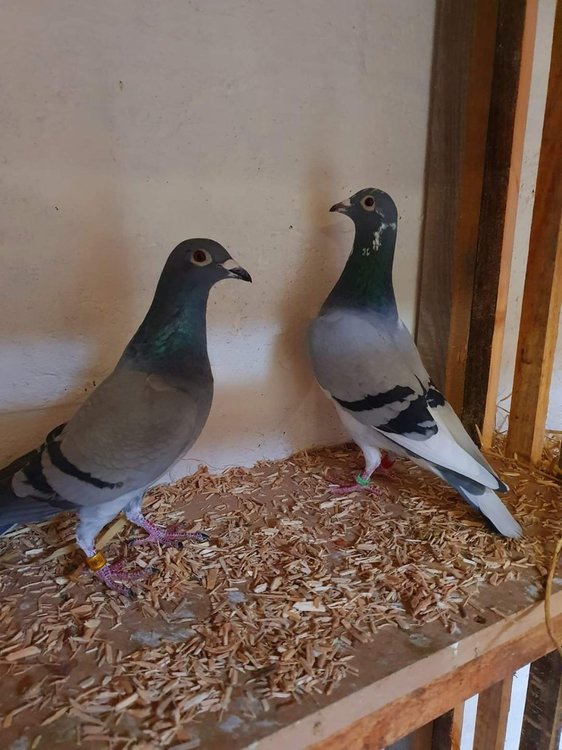
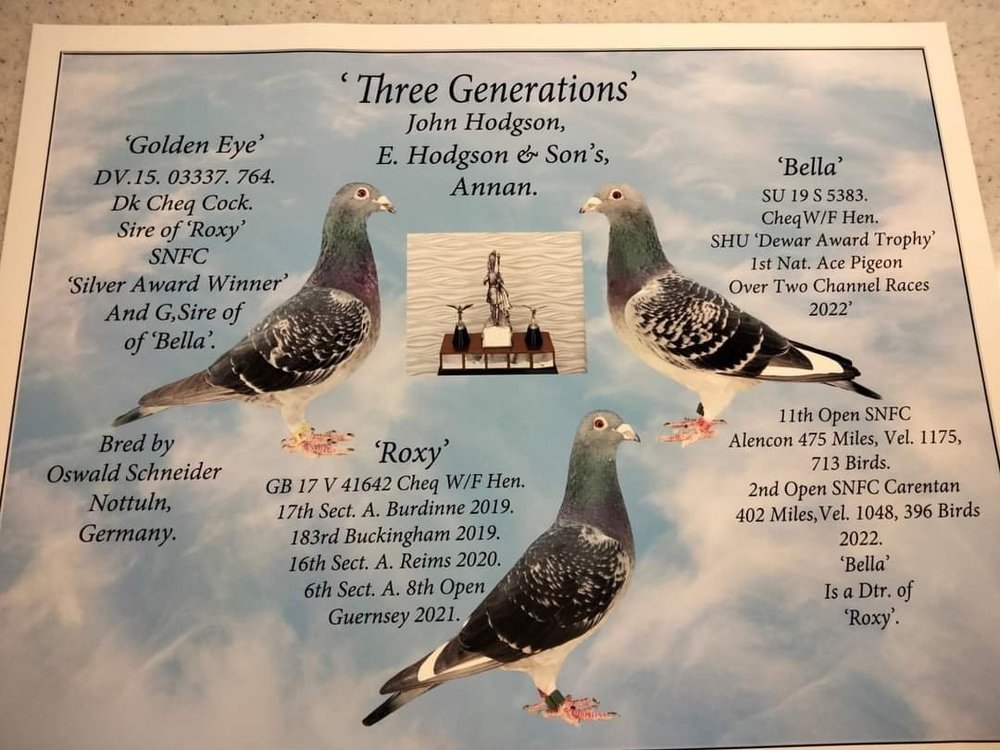
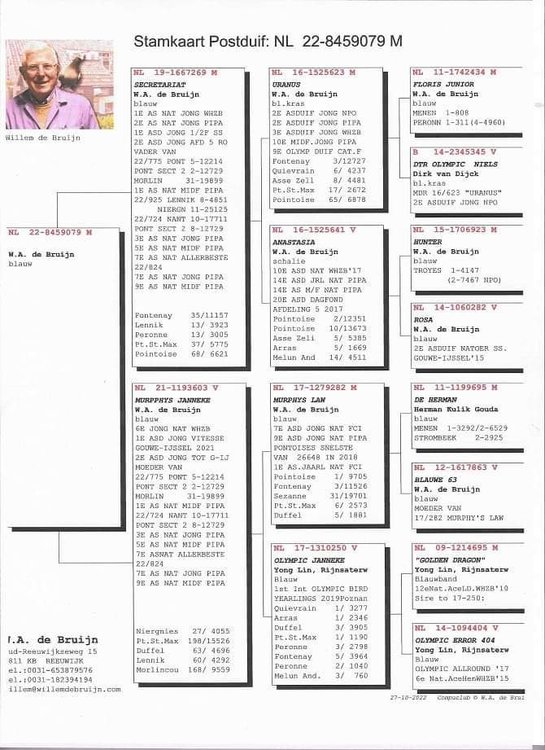
I am led to believe this is the pedigree of the bird that made £65,000 at a Stuart Wilcox Auction at Blackpool 2023
-
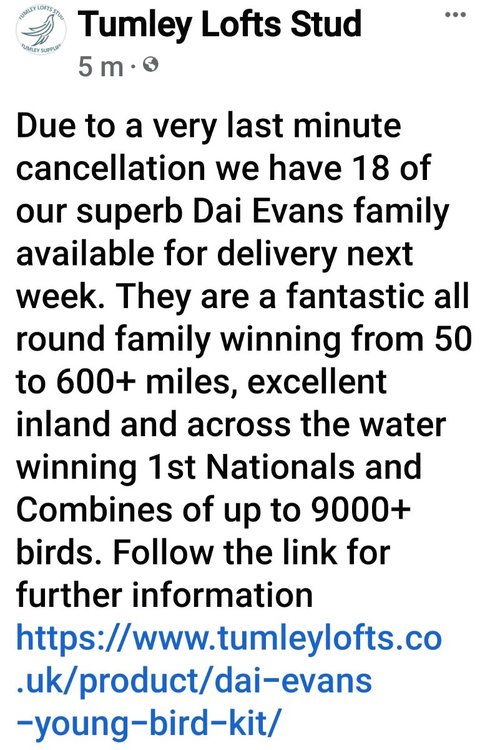
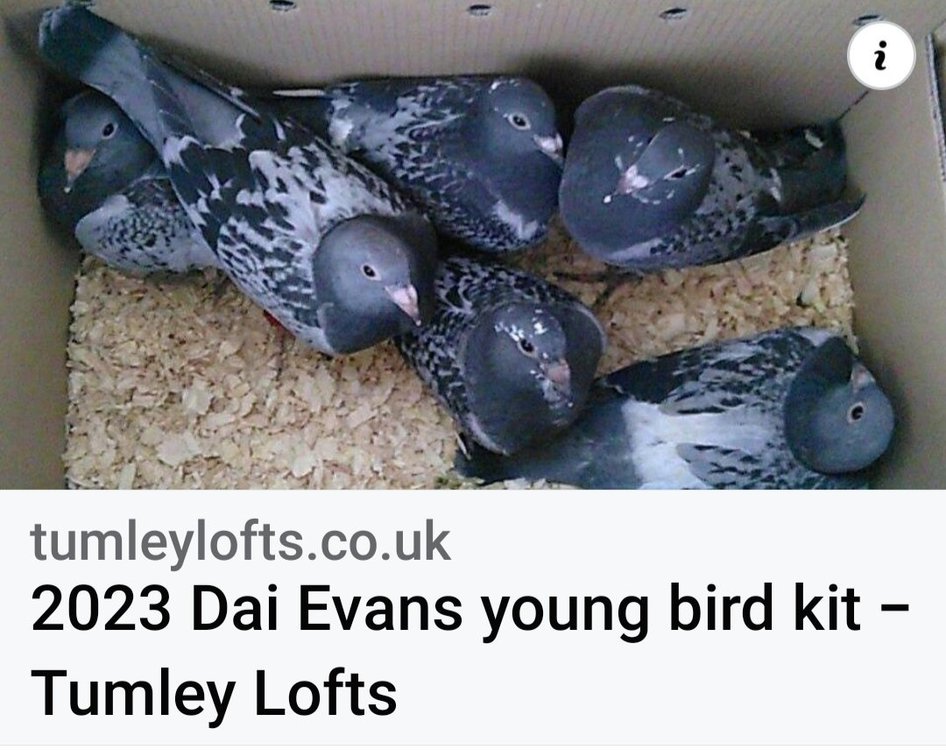
this is a copy, so links will not work
-

-
-
-
-
Ridiculous amount of money, only time will tell, if it lives upto expectations